No they weren’t - they were idealised clocks, ie measurement devices that do not rely on any specific mechanism. That is because the theory of relativity is not about the measurement devices at all, but about what they measure; more specifically, about the relationships between those measurements.
OK. Lets then play with idealized clocks.
If idealized clocks, like the clock in motion made with mirrors and light by Albert, are to be included to support the claims of a theory, these clocks at least must be inside the parameters of reason, reality and knowledge of physics. Albert knew the mechanical clocks, the solar clocks, the sand clocks, and similar.
A clock is a device calibrated to a fixed motion. The solar clock is a pole or wall that will work in accord to the shadow made by the sun. Marks or lines are traced besides the formed shadow to divide it in parts, and there you have a functional clock. Same with sand clock, the motion of the sand passing from one cone to the other will be calibrated filling it with a certain amount of sand.
The atomic clock is made with the same principle. In simple terms, is a device that carries a sensor that will count the vibrations of the atom of Cesium. Lets say, 9,192,631,770 vibrations will become a second, and so forth.
As you can see, there is not "the perfect clock" because nothing is perfect in our universe. The calibration of a clock can be altered by any outsider or insider condition. Atomic clocks also malfunction and even shot down without any warning. I think I watched the news of England atomic clocks in space failing by lots some years ago.
If you can manage to built us a mechanical clock that is sensitive enough to detect the required time intervals (measured in nanoseconds in this scenario), and has a high enough resolution to be meaningfully comparable to an atomic clock, then I’m sure someone might provide funding for such an experiment. In the meantime, we can compare other types of clocks that work on different mechanisms, eg masers vs atomic clocks:
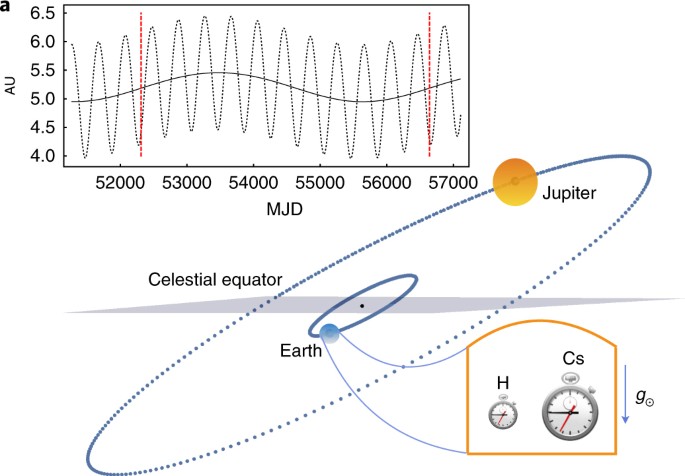
Years of data from atomic clocks around the world allow estimation of the variation of their rates with the spatial change of the solar potential. This allows the most precise null test of the local position invariance principle of general relativity.

www.nature.com
I wonder why no experiment had been made about it, like leaving a mechanical clock at the Space Station to be check by each group of astronauts year after year. The cost will be the donation of your Rolex and no further expenses are necessary by winding the watch.
Don’t be silly. There were no mechanical clocks in Einstein’s time that were even remotely capable of detecting these effects, so this is not what he “knew”. He also didn’t “invent” his theory out of thin air - there were already known discrepancies between Newtonian mechanics and observational data that greatly puzzled the physicists of the time, so he took those and developed them into a coherent framework.
Much more important though is that you have to understand that the theory specifically does not say that it is the clocks themselves that are affected, but rather that their relationship in spacetime changes - a clock is only ever dilated with respect to some other reference clock. It is a relationship between reference frames, not something that “happens” to any one clock. That is why it is irrelevant what type of clock is used - they are all affected equally, and no claim is made as to any specific clock mechanism. The theory simply isn’t about the clocks themselves, so all your demands about specific tests of specific mechanisms completely miss the point.
Yes. Every observer is associated with a reference frame, so those are synonymous in this context.
Newton and Einstein were both wrong in several things. The 1919 expeditions were made to check who was right, Newton or Einstein with regarding to the displacement of the image of a star caused by the gravity of the sun. Such experiment was simply a joke. The calculations made by Newton and Einstein were nonsense, Don't take me wrong, I don't say both of them were wrong in everything, but about checking the effects of gravity on light watching a star image displacement to prove gravity effects, using rudimentary telescopes, such was humorous.
When you say that all clocks are affected equally by gravity or speed, I guess you need to search better how each clock is made and calibrated. My hope is for you to find out by yourself that your claim is not valid