Is "Terminator 6" a really disturbing and depressive movie?

Spathi

Registered Member
I have watched the episodes T1-T4, but I didn't watch T5 and T6 because the reviewers said they both were rubbish. But I have read the spoilers in Wikipedia. As far as I understand, T5 is an amateur comic book film, like X-Men, nothing interesting. But T6 seems to be a serious, art-house film from the Master. I have read the spoilers and watched some flashbacks, and now it seems for me, that T6 is actually a good film, Cameron is great as usual, but T6 failed in cinemas for a different reason: it's frightening and depressing because it reminds us of the real threats of our present reality. In T3, the author made such a plot: while T2's ending suggested the heroes destroyed Skynet and saved everyone, in T3 the opposite is true - the attempt to prevent a catastrophe led to an even greater catastrophe. It can be depressing to think how humans can even win the future war, if the machines have such advanced cyborg models, while humans can't even produce an old T-850. And while it might have been possible to say that this was the T3 author's personal position, Cameron's authorship has now confirmed this plot again in T6.


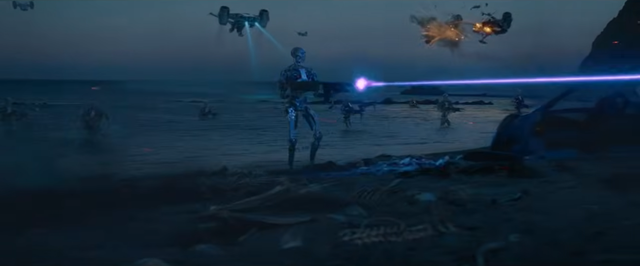
As in T1, in T6 the one arriving from the future is not a robot, but a living person, only cyberized. Below you can see spoilers for the film, including scenes of war in the future, but I'd recommend, maybe, preparing some Corvalol, and not watching everything at once:


As far as I understand, It's depressing only because when you leave the theater, you immediately remember all our current realities, in particular how AIs are rapidly improving every year...
 
I think a movie being depressive or disturbing relies on the exact same criteria as whether its enjoyable - its entirely down to the person watching and their chosen* line of engagement with the film.

every apocalypse film can be taken to be depressive and disturbing if taken as actually probable. if you decide to take that view point, the I'm sure it can be considered in a large number of negative ways. for me though, i choose to take the film for what it is - crazy thought experiment entertainment with cool graphics, story and premises.....

*now i say that as someone who can choose to take that detached view, and regulate my internal doom scrolling and catastrophising, if you are someone who cannot do that, then i feel for you because i can see how such a dark film moves from pure fantasy with no basis in reality, to oppressively overbearing and scary but i figure if this were the type of person i was - i wouldn't watch these type of films.

One thing i wanted to ask - do you often rate films that you haven't seen based on other people opinions? you seem to have concluded 5 is bad and 6 is good, solely on other people opinions - i am not criticizing, this just isn't something i can understand. i have enjoyed many a film/book/game/tv series that has been touted as being shit - because, i am not the people doing the touting....do you find your views are always in line with those who share their opinions and breakdowns online?

as for the specific content of the films and their potential connection to real life - i think there is a large step needed there, and i mean stepping backwards.... I'm not saying the stuff isn't possible at some point in the future, maybe even near future considering all the coalescing tech surrounding terminator films, but if i were to allow fear to run me, it would be far more based on real life tech than fantasy mega films like terminator....deep breaths my friend.... we arent there yet...

Peace and love.
 
Hamilton's initial instincts were apparently right. The decision to eliminate John Connor's relevance simply angered fans by (from their POV) rendering the earlier episodes of the franchise meaningless. Turning Dark Fate into a box office bomb. But on the other hand, JC's status was also degraded in the previous flick, and moviegoers didn't initially know that Genisys was going to be a stand-alone film that was not part of canon. However, the latter did underperform according to expectations, and maybe that was due to word-of-mouth finally catching up in the end. By the time Dark Fate came out, the fan base was already primed for the franchise's putative "woke" intent to eradicate JC's legacy.
  • TDF: The decision to kill the John Connor character came from Cameron, who wanted to surprise audiences who had become invested in the character's mythology: "It's like, 'Let's just get that right off the table. Let's just pull the carpet out from underneath all of our assumptions of what a Terminator movie is going to be about. Let's just put a bullet in his head at a pizzeria in the first 45 seconds.'"

    [...] Cameron believed that removing John Connor would prevent the film from feeling like a retread of previous films. Discarding John Connor allowed for new characters to be worked into the story. [...] Linda Hamilton was somewhat shocked by the decision to kill John Connor, which she believed would upset a lot of fans, but she also said she wanted the film series and its characters to evolve.
That trend to clear out "old heroes" to introduce diverse ones seems to affect movies more than TV shows. Lanterns, for instance, supposedly still had good ratings despite all the YouTube ranting about it dragging Hal Jordan's reputation through the mud (and also putting a bullet in his head). In the original comic book contexts, John Stewart and Jordan and Guy Gardner were somehow concurrent Lanterns rather than successors. But even the comics eventually trashed Jordan by turning him into the villain Parallax. (Emerald Twilight)
_
 
Last edited:
I suppose Spathi finds reviewers in whom he places confidence. Still, the usual thing with a movie thread is to watch the movie and then offer comments. If someone has watched the first four films, then I don't think dark subject matter is going to cause a problem for someone with that level of commitment to the franchise. My guess is they'll find it engrossing and thought-provoking more than depressing.
 
That trend to clear out "old heroes" to introduce diverse ones tends to affect movies more than TV shows
I tend to see fan service as a negative influence on artistic integrity. It also treats viewers like fussy children, because the money people don't see a good ROI in treating them like adults.
 
  • Like
Reactions: C C
I tend to see fan service as a negative influence on artistic integrity. It also treats viewers like fussy children, because the money people don't see a good ROI in treating them like adults.

In this era, probably have to find a middle ground between the two or else shift to lower-budget independent films (A24, etc) where profit loss or box office failure doesn't matter as much. But again -- excluding items like Doctor Who's apparent hiatus or Kurtzman's downfall in ST, angering a segment of the fans doesn't seem to carry such heavy consequences on television. And the latter is actually the best place for developing the "superhero" junk due to having an entire season for a story to unfold rather than jamming it into a two-hour movie.
_
 
Last edited:
In this era, probably have to find a middle ground between the two or else shift to lower-budget independent films (A24, etc) where profit loss or box office failure doesn't matter as much.
I see room for both.

For example, let JJ Abrams keep his "alternative timeline" for his version of Star Trek, and let Kurtzman stick to the fan-supported canon shows/movies.
 
I have a guess that in T1 and T2, Cameron had foreseen the realities of the current Russian-Ukrainian war, and what this war would become in the future.

In films, robots are always either standing with plasma guns or walking leisurely, as if they're too shy to crouch or run like humans. One could imagine this as robots perceiving themselves as Victors, who enjoying humiliating humans.

In Russia, Putin has made the word "victory" sacral for Russians. Vile pro-war militarists in Russia are called "vatniks," perhaps related to the god "Vayu-Vata" in Avestan mythology, the god of war and victory. Vatniks often humiliate Ukrainians. There's also a party in Turkey called "Vatan," which denies the genocide of Armenian people.
terminator-stands.png
 
I have a guess that in T1 and T2, Cameron had foreseen the realities of the current Russian-Ukrainian war, and what this war would become in the future.
A little history lesson: Ukraine left the Soviet Union 24 August 1991. "Terminator" was released 26 October 1984 , and "Terminator 2" was released 3 July 1991.

Do you perhaps spot any issue with Cameron "foreseeing the realities of the current Russian-Ukrainian war"?
Just asking.
In films, robots are always either standing with plasma guns or walking leisurely, as if they're too shy to crouch or run like humans. One could imagine this as robots perceiving themselves as Victors, who enjoying humiliating humans.
Hmmm. One could "imagine" almost anything one wants.
In Russia, Putin has made the word "victory" sacral for Russians. Vile pro-war militarists in Russia are called "vatniks," perhaps related to the god "Vayu-Vata" in Avestan mythology, the god of war and victory. Vatniks often humiliate Ukrainians.
The term has nothing to do with Vayu-vata, or any other deity. It's a padded quilted jacket that was/is regularly used by the Russian military, prisoners, labourers etc. The derogatory term came from reference to a cartoon character on a social media platform from 2011, that was basically a vatnik (jacket) portrayed as a propaganda-loving Russian loyalist. Hence referring to such people as "vatniks". The derogratory gained popularity in 2014 with the Ukraine invasion, and the vatnik-wearing military on display.
There's also a party in Turkey called "Vatan," which denies the genocide of Armenian people.
Okay. But this is another entirely different etymology. It may look the same in the Roman alphabet, but not all similar order of letters are due to common roots, especially when translated across various alphabets, different histories, different peoples.

You know, you could look all this up for yourself prior to posting. Would save you having to type out all the wrong. ;)
 
Do you perhaps spot any issue with Cameron "foreseeing the realities of the current Russian-Ukrainian war"?
Just asking.
What is strange for you? I don't understand your question.
The term has nothing to do with Vayu-vata, or any other deity. It's a padded quilted jacket that was/is regularly used by the Russian military, prisoners, labourers etc. The derogatory term came from reference to a cartoon character on a social media platform from 2011, that was basically a vatnik (jacket) portrayed as a propaganda-loving Russian loyalist. Hence referring to such people as "vatniks". The derogratory gained popularity in 2014 with the Ukraine invasion, and the vatnik-wearing military on display.
I have one more point to add: Russian "vatniks" love the meme "after peremoga, a zrada always comes". The Ukrainian word "peremoga" means "victory", the word "zrada" means "betrayal", sometimes vatniks interpret it as "a peremoga ruined by Russians". This is one more way the vatniks humiliate Ukrainians.
 
What is strange for you? I don't understand your question.
Ukraine was still part of Russia when T1 and T2 were released.
But, heck, you can guess whatever you want. Don't let reality stop you. ;)
 
What is strange for you? I don't understand your question.
He could not have been commenting on the Russian-Ukranian war. He could not even be SPECULATING about the Russian-Ukrainian war because back then there WAS no Ukrainian country - just the USSR.
 
He could not have been commenting on the Russian-Ukranian war. He could not even be SPECULATING about the Russian-Ukrainian war because back then there WAS no Ukrainian country - just the USSR.
What Spathi meant was Cameron commented on a Ukraine that was to be. So he saw the break up of the Soviet Union, Ukraine independence, some stuff in 2014, THEN the invasion but by people not robots and that is where the drones come in, not Russian, Ukraine, then COVID.
Since COVID came a full two years before the invasion that was Connor going back in time, COVID/Connor. Simples.
 
Cameron could feel many things, understand them at least subconsciously, and predict the future, even at that time.
 
You do know that Cameron wasn't the first to use the idea of robots/machines turning into the enemy, right? Nor was he the first to make a film about the rise of an AI? Or about time travel? etc.
 
You do know that Cameron wasn't the first to use the idea of robots/machines turning into the enemy, right? Nor was he the first to make a film about the rise of an AI? Or about time travel? etc.
Yes but he was one of the first to start feeling about things, like Spathi said.
 
Yes but he was one of the first to start feeling about things, like Spathi said.
Well, yes, of course. Prior to Cameron we lacked all such ability, everyone knows that. Anyhoo - I've been feeling many things... and some even appreciated it. ;) I guess I have Cameron to thank for that, foreseeing it as he did. :)
 
Cameron could feel many things, understand them at least subconsciously, and predict the future, even at that time.
You do realize that Cameron produced - but did not write - that movie, right? Specifically it was written by David Goyer, Justin Rhodes and Billy Ray.

And what's more likely in your mind?

-They were Nostrodamus-like prophets who subconsciously weaved their predictions into their movie
-They wrote a movie they thought would sell well
 
Also, of note, is that Harlan Ellison sued the production companies upon the release of the "original" (ironic) Terminator film for what he saw as ripping off a short story "Soldier from Tomorrow" and an episode of The Outer Limits (thanks Wiki for this titbit of info) that Ellison penned. Who'dathunkit. ;) It was settled out of court, which can be read as "guilty as charged!" but apparently Cameron wasn't happy with the resolution. He's a good director, but his ideas are... not original (heck, few are!).
 
Back
Top